Quotient Groups
Recall the construction of : we put an equivalence relation on , take equivalence classes, and then add classes by choosing representatives. This was our first quotient group. We now seek to generalize and understand this construction for arbitrary groups . This will be another way to obtain a “smaller” group from , and it can also be used to study the structure of , like subgroups did.
Here is a perspective that helped me a lot: The study of quotient groups of is essentially equivalent to the study of homomorphisms of to another group. Let be a homomorphism and recall that the fibers of are the sets of elements of projecting to single elements of . You can picture this as in the following figure.
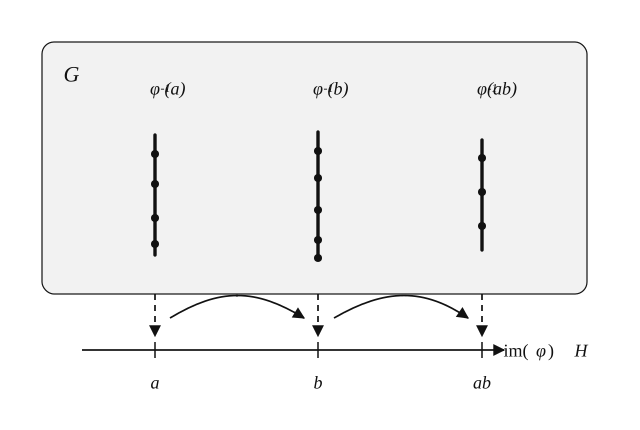
The group operation in provides a way to multiply two elements and in the image of . This gives a natural multiplication of the fibers lying above those two points. This then makes the set of fibers into a group. This is a quotient group — has been partitioned into pieces and these pieces have the structure of a group.
Since the multiplication of fibers is defined from multiplication in , it is easy to see an important fact: this quotient group is isomorphic to . We now need to make all of this precise: how do we form a quotient group from a group without having a homomorphism to another group? The answer is that we need to find a way to partition into pieces that “behave like fibers”, and we will see that the answer is normal subgroups.
Cosets and Lagrange’s Theorem
Definition
Let be an equivalence relation on a group . We say that is compatible with multiplication if, whenever , we also have
for every .
Lemma
Let be a group and let be an equivalence relation on . The rule
is well-defined on the set of equivalence classes if and only if is compatible with multiplication. In that case, is a group under this operation.
Proof
Suppose first that is compatible with multiplication. If and , then and . Compatibility gives
so by transitivity . Hence , and the product of classes is well-defined.
Conversely, suppose is well-defined. If , then , so for any ,
Thus . Similarly,
so . Therefore is compatible with multiplication.
Finally, if the operation is well-defined, the group axioms are inherited from :
the identity is , and the inverse of is .
Definition
If is an equivalence relation on a group compatible with multiplication, then the group of equivalence classes is called the quotient group of by .
Example
Let and fix an integer . Let be congruence modulo . This equivalence relation is compatible with addition, and
Now we need a systematic way to produce equivalence relations on groups. Subgroups give the most important examples.
Definition
Let be a subgroup. A left coset of in is a subset of of the form
for some . A right coset of in is a subset of of the form
for some .
Example
Let and let . Since is abelian, the left and right cosets are the same:
These are exactly the congruence classes modulo .
Coset criterion
Let and let . Then
Equivalently, and lie in the same left coset of exactly when . The same statement holds for right cosets.
Proof
If , then , so for some and hence . Conversely, if , then , and
Since is closed under inverses, if and only if . The right coset statement is exactly the same.
Proposition
Let . The left cosets of in partition , and the right cosets of in also partition .
Proof
We prove the statement for left cosets. Every element belongs to at least one left coset, namely , since and .
Now suppose two left cosets and intersect. Choose . Then lies in the same left coset as and also in the same left coset as . By Lemma Coset criterion, and , so . Thus any two left cosets are either equal or disjoint.
Proposition
Let . Every left coset and every right coset of has the same cardinality as . More precisely, for every ,
Proof
The map
is surjective by definition of . It is injective because implies after multiplying on the left by . Thus .
Similarly, the map
is a bijection, so .
Definition
The index of a subgroup in a group , denoted , is the number of left cosets of in . Equivalently, it is the number of right cosets of in .
Now, we prove a statement older than the modern definition of a group. Lagrange’s theorem says that the order of a subgroup must divide the order of the group.
Lagrange's theorem
Let be a finite group and let . Then
In particular, divides .
Proof
The left cosets of partition , and each left coset has elements. If there are left cosets, then
One reason Lagrange’s theorem is important is that it turns counting information about a group into arithmetic information about its elements.
Fermat's little theorem
Let be prime. The nonzero congruence classes modulo form a group under multiplication:
This group has elements. If is an integer not divisible by , then . By Lagrange’s theorem, the order of the subgroup divides . Therefore
or equivalently
This is Fermat’s little theorem. If , multiplying both sides by gives
and if , the same congruence is immediate.
The converse of Lagrange’s theorem is false: if divides , there need not be a subgroup of of order . The strongest general converse is given by the Sylow theorem, which we will not prove.
Sylow
If is prime and divides , then has a subgroup of order .
At this point, these cosets are looking a lot like the equivalence classes we need to form a quotient group, or the fibers of a homomorphism we introduced in the beginning. That is, what we’d like to do is use if and are in the same coset. But there is a critical problem: the left and right cosets need not be the same. This is exactly the obstruction to being compatible with multiplication.
Example
Let and let , where is a reflection. The left cosets of are
The right cosets are
These lists need not be the same. For example, lies in the left coset , while its right coset is . Since and , we have .
If we choose certain subgroups it works out:
Example
Again let , but now let be the subgroup of rotations. The left cosets are
while the right cosets are
In this case , so the left and right cosets agree. Since , we have .
This is because is a normal subgroup of , which we will explore in the next section.
Exercise
In , let . List the left cosets of . Then show directly that the rule
is not well-defined.
Normal subgroups
The examples at the end of the previous section show that left and right cosets do not always agree. This is exactly the obstruction to multiplying cosets in a sensible way. The subgroups for which this obstruction disappears are called normal subgroups.
Definition
The element is called the conjugate of by . Thus a subgroup is normal if it is closed under conjugation by every element of the ambient group.
Remark
Just to be clear, you dont ask if a group is normal. Normality is a property of a subgroup inside a group, and it has very little to do with the actual structure of the subgroup.
Here are many examples of normal subgroups.
Example
Every group has two trivial normal subgroups:
Example
Every subgroup of an abelian group is normal. Indeed, if is abelian and , then
for all and . Hence for every .
Example
More generally, for any group , the center
is normal in .
Exercise
Prove that the kernel of a group homomorphism is a normal subgroup.
The following proposition gives some useful criteria for checking normality.
Proposition
Let . The following conditions are equivalent:
- .
- for every .
- for every .
Proof
Clearly (1) implies (2). Conversely, if for every , then applying this to gives . Conjugating by gives , so . Thus (1) and (2) are equivalent.
Also, if and only if , by multiplying on the right by . Thus (1) and (3) are equivalent.
Exercise
Prove that every subgroup of index is normal.
Exercise
Let be a group homomorphism and let . Prove that
So how do we find normal subgroups? We’ve already show that kernels of homomorphism are normal, but in fact, these are the only examples.
Proposition
A subgroup is normal if and only if it is the kernel of some homomorphism .
Proof
Deferred till later.
Remark
The relation “is a normal subgroup of” is not transitive. Let
One can show that . Since is abelian, the subgroup
is normal in . But is not normal in , because
We will end with an example which is part of the motivation for Galois to create group theory.
Definition
A permutation in is even if it can be written as a product of an even number of transpositions. The alternating group is the set of all even permutations in .
Remark
In Chapter 1 we proved that every permutation is a product of transpositions. What is not obvious is that the parity of the number of transpositions is well-defined: a permutation cannot be written both as a product of an even number of transpositions and as a product of an odd number of transpositions. Equivalently, there is a well-defined homomorphism
which sends even permutations to and odd permutations to .
Proposition
For , the alternating group is normal in .
Proof
By the previous remark, Since kernels of homomorphisms are normal, .
Remark
At the time, formulas for solving polynomial equations were being sought (like the quadratic formula). Such formulas were known for polynomials of degree , , and , but not for degree or higher. He wanted to show that a general quintic polynomial is not solvable by radicals. We will return to this story later and sketch how he proved this.
Quotient groups
We now arrive at the point of normal subgroups: they are exactly the subgroups for which we can multiply cosets in a well-defined way.
Theorem
Let . The operation
makes the set of left cosets of in into a group if and only if .
Proof
Suppose . We first check that the operation is well-defined. If and , then and for some . Since is normal, , and hence
Therefore . The identity is , the inverse of is , and associativity follows from associativity in .
Conversely, suppose the formula gives a well-defined group operation on the set of left cosets. If and , then , so well-definedness gives
Hence . By Proposition normality criteria, .
Definition
Let . The quotient group is the group whose elements are the left cosets of in , with multiplication
The identity element is and the inverse of is .
This is the same quotient group as , where is the equivalence relation defined by if and only if . The equivalence classes of are exactly the left cosets of in .
Remark
Since is normal, the left and right cosets of agree. Thus we can also view as the set of right cosets of in , with multiplication
Remark
The order of the quotient group is the index of in :
If is finite, then Lagrange’s theorem gives
Example
Let . Since , it is normal in . Fix a transposition . The coset consists exactly of the odd permutations: every product with is odd, and if is odd, then , so . Thus the two cosets are , the even permutations, and , the odd permutations. Therefore has order , and hence
Exercise
Let and let . Prove that the order of is the smallest positive integer such that , if such an exists. Use this to compute the orders of all elements of
Remember the motivation from the beginning of this chapter: we should think of the quotient group as the set of fibers of a homomorphism from to another group. The next lemma makes this precise.
Definition
Let . The map
is called the canonical quotient map, the canonical surjection, or the canonical projection from to .
Lemma
Let . The canonical quotient map
is a surjective group homomorphism with kernel .
Proof
Surjectivity is immediate: every element of has the form for some . The map is a homomorphism since
Using Lemma Coset criterion, its kernel is
Proposition normal groups are kernels
A subgroup is normal if and only if it is the kernel of some homomorphism .
Proof
If is the kernel of a homomorphism, then the earlier exercise shows that is normal. Lemma quotient homomorphism gives the converse.
Example
The infinite dihedral group is the set
with multiplication determined by
Informally, this is the group with presentation
For , the subgroup is normal in , and
The isomorphism is induced by sending
Exercise
Let with . In , prove that , and prove that
Remark
In the previous example, both and are infinite, but the quotient is finite. Thus a quotient of an infinite group by an infinite subgroup can be finite.
A quotient of an infinite group by an infinite subgroup can also be infinite. For example, in the additive group , the subgroup is normal, and the quotient has one coset for each possible second coordinate. In contrast, every quotient of a finite group is finite.
Definition
Let be a group. For , the commutator of and is the element
The commutator subgroup, or derived subgroup, of is the subgroup generated by all commutators:
We have if and only if . More generally, if and only if is abelian. Thus the commutator subgroup measures how far is from being abelian.
Exercise
Show that is a normal subgroup of . Hint: first show that
Exercise
Let be a group. Define the abelianization of as . Prove that the abelianization is the largest abelian quotient of , in the following sense: if and is abelian, then .
Exercise
Compute the commutator subgroups and . Then determine and .
It is now time to prove the isomorphism theorems, which explain how homomorphisms and quotient groups fit together.
Isomorphism Theorems
Take any homomorphism . As we showed, the kernel is a normal subgroup of (and in fact all normal subgroups arise as kernels of homomorphisms), so we may take the quotient group . Now, think back to the picture we have of quotient groups as fibers of a homomorphism. This picture makes it clear that the quotient group is isomorphic to the image of in . This is the first fundamental isomorphism theorem, which we now state and prove.
First Isomorphism Theorem
If is a homomorphism of groups, then and .
Proof
We have already shown that . Define a map
This is well-defined: if , then , so and hence . The map is surjective by definition of the image, and it is injective because if , then and hence .
Example
Suppose is a linear transformation of finite-dimensional vector spaces. Then the first isomorphism theorem implies that . This is the the rank-nullity theorem, which says that
Example
The First Isomorphism Theorem gives a second proof of the classification of cyclic groups. Let and define
This is a surjective homomorphism. If has infinite order, then , so . If has finite order , then , so the First Isomorphism Theorem gives
Example
Let be a field and let . The determinant map
is a surjective group homomorphism. Its kernel is
Therefore , and the First Isomorphism Theorem gives
Example
Let and let . Since is abelian, . The absolute value map
is a surjective homomorphism with kernel . Hence
To state the Second Isomorphism Theorem, we first need a small piece of notation.
Definition
Let and be subgroups of a group . Define
In general, is only a subset of , not necessarily a subgroup.
Remark
The subsets and are both contained in : for example, for every , and for every .
Exercise
Let and be subgroups of .
- Prove that is a subgroup of if and only if .
- Prove that if at least one of or is normal in , then
- If both and are normal in , prove that is normal in .
Remark
The equality does not mean that every element of commutes with every element of . It is an equality of subsets.
Second Isomorphism Theorem
Let be a group, let , and let . Then
and there is an isomorphism .
Proof
Since is normal in , Exercise products of subgroups gives . Also, because , and because .
Let
This is the composition of the inclusion with the canonical projection , so it is a homomorphism. The map is surjective because every element of has the form , with and .Finally,
The result follows from the First Isomorphism Theorem.
Corollary
If and are finite subgroups of and , then
Lattice Isomorphism Theorem
Let be a group, let , and let be the canonical projection. There is an order-preserving bijection
given by
This correspondence has the following properties:
- if and only if .
- if and only if .
- .
- If , then
and
Exercise
Let , and let be the canonical projection.
(a) If contains , prove that
Where does your proof use ?
(b) If , prove that contains and that
Conclude that and give mutually inverse bijections between the subgroups of containing and the subgroups of .
You may use the fact that images and preimages of subgroups under homomorphisms are subgroups.
Proof of the Lattice Isomorphism Theorem
By the preceding exercise, the assignments and are mutually inverse bijections. It remains to prove the four stated properties. We use the identities and established in that exercise. In particular, whenever , we have
If , taking images gives . Conversely, if , taking preimages gives .
If , then for every and , so . Conversely, if , the same calculation gives . The membership equivalence above gives , so .
The map is a bijection between the sets of left cosets. Indeed,
This proves that the map is well-defined and injective. It is surjective because every element of has the form . Hence , whether the indices are finite or infinite. Here need not be normal, so these are coset sets, not necessarily quotient groups.
- For , we have if and only if , which is equivalent to . Thus . For generated subgroups, set and . The subgroup contains and , so . Conversely, contains and , so . Taking images gives . Therefore .
Example
Let and let . Since is abelian, . The Lattice Isomorphism Theorem says that the subgroups of containing correspond exactly to the subgroups of .
The subgroups of containing are
Under the correspondence , these become the subgroups of :
The two lattices have exactly the same shape:
For example, on the left
On the right, the corresponding statement is
The theorem says that every inclusion, intersection, and generated subgroup visible in the left lattice is preserved in the quotient lattice.
Of course, the actual subgroup structure of is much much larger than the one shown here — you should think that describes the structure of “above” the normal subgroup .

The canonical projection is the basic map out of that kills every element of . The next theorem says that any homomorphism out of that kills must come from a unique homomorphism out of .
Universal mapping property of quotient groups
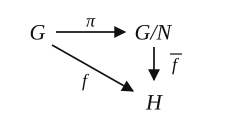
Let be a group and let . Let be a group homomorphism such that . Then there exists a unique group homomorphism
such that the diagram
commutes. Equivalently, for every .
Moreover,
Proof
If such a map exists, then it must satisfy
so uniqueness is forced.
To prove existence, define
We must check that this is well-defined. Suppose . Then , so
Hence , so the value of does not depend on the chosen representative.
The map is a homomorphism because
By construction, .
The image statement follows from the formula . Finally,
Therefore .
In short, to define a homomorphism out of , it is enough to define a homomorphism out of whose kernel contains .
Exercise
The braid group is generated by symbols subject to the relations
and
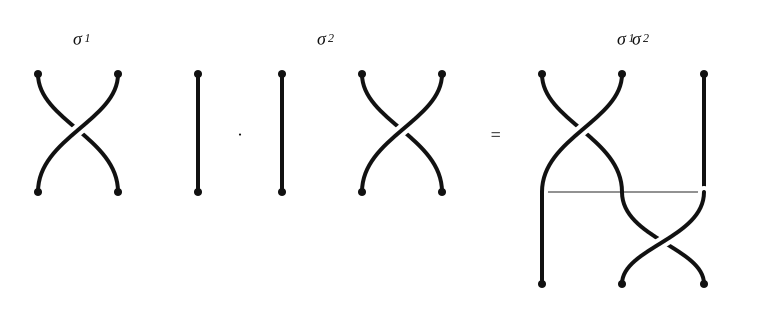
The generator represents the braid where strand crosses over strand . Products of braids are formed by stacking one braid on top of another:
The second displayed relation is a three-strand braid move. It is not the relation : doing the same crossing twice is usually not the identity braid.
Show that forgetting the crossing information and recording only the final order of the endpoints defines a surjective homomorphism
Describe the kernel geometrically; it is called the pure braid group . Then prove that imposing the additional relations on gives the symmetric group . We often think of an element of as performing a shuffle on a set of points — remembers the “movie” of this shuffle.
Exercise
Let be a group and let be an abelian group. Show that every group homomorphism
factors uniquely through the abelianization .
Exercise
Prove that if is cyclic, then is abelian.
The third isomorphism theorem considers the question of taking quotient groups of quotient groups. In short, they cancel like fractions and we gain no new structural information from taking quotients of a quotient group.
Third Isomorphism Theorem
Let be a group and suppose
Then , , and there is an isomorphism
Proof
Since , we have . Consider the canonical projection
Since , the universal mapping property gives a homomorphism
This map is surjective, and its kernel is . Therefore , and the First Isomorphism Theorem gives
Composition Series and the Hölder Program
The isomorphism theorems tell us how to understand a group by passing to quotients. Composition series push this idea as far as it can reasonably go: break a group into simple quotient groups, in the same spirit that an integer is broken into prime factors.
Definition
A nontrivial group is called simple if its only normal subgroups are
Simple groups are the groups which cannot be broken down further using normal subgroups and quotients. They are the “atoms” or “prime numbers” of group theory.
Example
If is prime, then is simple. Indeed, its only subgroups are
and every subgroup of an abelian group is normal.
Proposition
The simple abelian groups are exactly the cyclic groups of prime order.
Proof
We have already seen that is simple when is prime.
Conversely, let be a simple abelian group, and choose a nonidentity element . Since is abelian, every subgroup of is normal. The subgroup is nontrivial, so simplicity forces
Thus is cyclic. If were infinite cyclic, then it would have a proper nontrivial subgroup, for example . Hence is finite cyclic. If were composite, then would have a proper nontrivial subgroup. Therefore is prime.
If simple groups are the “primes”, we would wish for a “unique factorization theorem” for finite groups. We now describe this program, which was initiated by Hölder in 1889.
Definition
A composition series for a group is a finite chain of subgroups
such that each quotient is simple. The simple groups are called the composition factors of the series.
The notation is important. We do not require every to be normal in all of ; we only require it to be normal in the next group in the chain.
Example
If is simple, then
is a composition series. Its only composition factor is itself.
Example
In , one composition series is
The composition factors are
Another composition series is
whose composition factors occur in the order
Note: the order changed, but the list of factors did not.
Example
Note that in , we have two composition series
In each series there are three composition factors, each of which is isomorphic to the simple group .
Proposition
Every finite group has a composition series.
Proof
We argue by induction on . If is simple, then is a composition series. If is not simple, choose a proper normal subgroup which is maximal among proper normal subgroups of . Such an exists because is finite. By the Lattice Isomorphism Theorem, the quotient has no nontrivial proper normal subgroups, so is simple.
Since , the induction hypothesis gives a composition series
for . Appending gives
and the new final quotient is simple. Therefore this is a composition series for .
Jordan--Hölder theorem
Let be a finite group. Any two composition series for have the same length, and after reordering their factors, the two lists of composition factors are isomorphic term-by-term.
We will not prove the Jordan—Hölder theorem here. The proof is a refinement argument: one compares two normal chains by cutting each chain with the subgroups in the other chain, then uses the isomorphism theorems to identify the new quotient factors.
Remark
Composition factors behave like prime factors of an integer. A composition series is not unique, just as a factorization can be written in different orders. The Jordan—Hölder theorem says that the simple factors themselves are unique up to reordering.
Remark
The analogy with prime factorization is useful but imperfect. Knowing the composition factors of a group does not determine the group. For example, both
have two composition factors, both isomorphic to , but the groups are not isomorphic. Composition factors describe the simple pieces; they do not describe all the ways those pieces can be glued together.
After this, the Hölder program was to:
-
classify all finite simple groups, and
-
find all ways of putting them together to form other groups.
Step (1) was completely in about 1980, 100 years after the program was launched. The efforts of over 100 matehamticians covering about 5000-10000 pages of journal pages over 300-500 individual papers.
Theorem
There is a list consisting of 18 infinite families of simple groups and 26 simple groups not belonging to this family (the sporadic groups) such that every finite simple group is isomorphic to one of the groups in the list.
Definition
A finite group is called solvable if it has a composition series whose composition factors are all cyclic of prime order.
By the Jordan—Hölder theorem, if one composition series for a finite group has only cyclic prime-order factors, then every composition series does. Thus solvability is a property of the group, not of the chosen composition series.
Example
Every finite abelian group is solvable. Indeed, every composition factor of a finite abelian group is abelian and simple, hence cyclic of prime order.
Remark
The name “solvable” points back to Galois’s original goal: understanding when polynomial equations can be solved by radicals.
Very roughly, a polynomial has a group attached to it, called its Galois group. This group records the permutations of the roots that preserve all algebraic relations among those roots. For example, the roots of a polynomial may be labeled
and the Galois group is a subgroup of describing which permutations of these roots are compatible with the algebraic structure of the equation.
Solving a polynomial by radicals means building its roots by repeatedly adjoining expressions such as square roots, cube roots, and more generally th roots. On the group-theoretic side, these radical adjunctions contribute only cyclic prime-order composition factors. Thus Galois theory proves the following fundamental principle:
This turns the existence of radical formulas into a group-theoretic question. The general quintic has Galois group . In the following exercise, you will show that is not solvable, achieving Galois’s goal.
Exercise
A fact that we will not prove is simple — this is easy, but messy. Using this fact, prove that is not solvable.
Exercise
Let
Prove that
is a composition series, and list its composition factors.
The classification of finitely generated abelian groups
For finite abelian groups, composition factors are especially simple: they are all cyclic groups of prime order. The Jordan—Hölder theorem then records the primes that appear, counted with multiplicity. For instance, every abelian group of order has composition factors
in some order.
But now we need to understand goal (2); how these can be glued together. Fortunately, we know how to do this in this case.
Theorem
Every finitely generated abelian group is isomorphic to a group of the form
where , each , and
Moreover, the integer and the integers are uniquely determined by the group.
Example
What are all the possible finite abelian groups of order ? The prime factorization is
The -part of the group can be either or , and the -part of the group is . Therefore the two possible abelian groups of order are