Representation Theory
Representation theory is a way of studying groups by letting them act on vector spaces. The point is that linear algebra gives us tools that are very concrete: matrices, eigenvalues, traces, dimensions, and decompositions.
In this chapter we follow the beginning of Serre’s Linear Representations of Finite Groups. We will work with finite groups and finite-dimensional complex vector spaces. This is already a rich setting, and it is the setting where the basic structure theorems have their cleanest form.
Definitions and Examples
Let be a group and let be a finite-dimensional vector space over .
Definition
A (complex) representation of in is a group homomorphism
As a reminder, is the group of linear automorphisms of called the general linear group, or if , the group of invertible matrices.
In other words, a representation of is a pair , which associates to each element an invertible linear map in such a way that
After choosing a basis of , each becomes an invertible matrix. In this way, we are trying to represent the abstract group by matrices. Most people will abuse notation supress from the notation when its understood, and say that is a representation of .
Example
Let be any finite-dimensional complex vector space. The rule for every defines a representation of . This is called the trivial representation.
Example
Suppose . In this case, a representation is a map
Since is finite, every element has finite order. If , then
Thus is a root of unity for every .
Exercise
This exercise will complete a classification of one-dimensional representations of a finite group .
- Show that uniquely factors through the abelianization . (Hint: look at previous exercises…)
- Show that if is a cyclic group, then the one-dimensional representations of are in bijection with the -th roots of unity, where .
- Use the classification of finite abelian groups to describe all one-dimensional representations of .
Example
The sign representation of is the one-dimensional representation
Even permutations act by multiplication by , and odd permutations act by multiplication by . This is a representation because if you multiply two even permutations, you get an even permutation, and if you multiply two odd permutations, you get an even permutation. If you multiply an even and an odd permutation, you get an odd permutation. In all cases, the sign of the product is the product of the signs.
Example
Recall that acts naturally on the set by permutating the elements. There is an extremely natural representation here on the -dimensional vector space . Let be the standard basis of , one for each element in . For each permutation , define
So for example, if and , then
We call this the permutation representation associated with .
Example S_n permutation representation extends to a general construction for any group action on a finite set .
Definition
Let be the complex vector space with basis . For each , define the permutation representation of by
Since the action satisfies , the maps satisfy .
Recall that every finite group acts on itself by left multiplication. This gives a permutation representation of on a vector space of dimension with basis . This is called the regular representation of .
Example
If , then the regular representation is 6-dimensional, with one basis vector for each permutation in . Order the basis as
In this basis, the matrix for is
Example
If , then the regular representation of is a representation in a three-dimensional vector space with basis , and the group elements act as follows:
So as a matrix, is the matrix
Note that this is the same matrix as the natural permutation representation of , after identifying with .
Exercise
Let be a finite group. The group algebra is the complex vector space with basis . Define multiplication on basis vectors by
and extend this rule bilinearly, so that
- Show that this multiplication is associative and has identity element .
- Show that is commutative if and only if is abelian.
- For each , left multiplication by sends to . Explain why this recovers the regular representation described above.
As usual, we have a notion for when objects are the isomorphic to each other. As usual, it means that there is a homomorphism that respects the structure of the objects.
Definition
Two representations and of are called isomorphic if there is an isomorphism of vector spaces such that
for all . In other words, the following diagram commutes for all :
People call such a map a -equivariant linear map. More generally, a homomorphism from one -representation to another is a homomorphism respecting the -action in the same way.
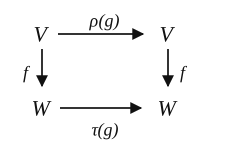
Isomorphic representations are the same representation written in different coordinates. If bases are chosen for and , then the condition above says that the matrices for one representation are obtained from the matrices for the other by a single change of basis.
Remark
There is a pattern here that appears throughout modern mathematics. Once we decide what kinds of objects we want to study, we also have to decide what the structure-preserving maps between them should be. For representations of , the objects are representations, and the structure-preserving maps are -equivariant linear maps. The isomorphisms are exactly the invertible -equivariant linear maps. The subject that studies this general pattern of objects and morphisms is called category theory.
Subrepresentations and irreducibility
A representation is a vector space together with a compatible action of . Therefore the right analogue of a subgroup is not just a subset, but a linear subspace that is preserved by the action.
Definition
Let be a representation of . A subspace is called a subrepresentation if
for every . Sometimes we call G-stable or invariant under .
This is what is needed in order for the restriction
defines a representation of on . Since is invertible, the condition is equivalent to for every .
Example
Let act on a finite set , and let be the associated permutation representation with basis . The vector
is fixed by every element of , because each only permutes the basis vectors. Therefore the line is a subrepresentation, and acts trivially on it.
Lemma
Let be a -equivariant linear map between representations of . Then is a subrepresentation of , and is a subrepresentation of .
Proof
Let , so . Then for any ,
so . Therefore is a subrepresentation of .
Let , so for some . Then for any ,
so is a subrepresentation of .
Example
Every representation has two automatic subrepresentations:
These are called the trivial subrepresentations.
Definition
A nonzero representation of is called irreducible if its only subrepresentations are and .
Later, Maschke’s theorem will tell us that every finite-dimensional complex representation of a finite group can be built as a direct sum of irreducible representations. Irreducible representations are therefore the basic building blocks of representation theory. They are the “simple groups” of representation theory.
Example
Every one-dimensional representation is irreducible. Indeed, a one-dimensional vector space has only two subspaces: and the whole space.
Example
If is nontrivial, then the regular representation of is not irreducible. The line
is a one-dimensional subrepresentation, and it is not the whole regular representation because .
Proposition
All irreducible representations of are one-dimensional.
Proof
Let be a generator for , and let be an irreducible representation. Let be an eigenvector for , so . Consider the complex line ; it is preserved by and by all of its powers and thus is preserved by every group element. Therefore its a subrepresentation of and must be irreducible since its -dimensional.
There are also multiple ways to create representations from existing ones. The most basic is to take their direct sum.
Definition
Let and be representations of . Their direct sum representation is the representation on defined by
for every , , and .
Example
Let us return to the natural action of on the set . The corresponding permutation representation is the representation on with standard basis given by
There is a one-dimensional subspace
on which every permutation acts trivially. There is also an -dimensional subspace
This subspace is preserved by every permutation, and the resulting representation on is called the standard representation of .
In fact,
To see this, write and let
Then
where the first term lies in and the second lies in .
Exercise
This exercise shows that for , the standard representation of is irreducible. Suppose is a nonzero subrepresentation of the standard representation
- Let be a nonzero vector in . Show that there must be such that .
- Show that the transposition satisfies . Conclude that for any .
- Show that the vectors for span the standard representation. Conclude that is the whole standard representation.
Schur’s Lemma and Maschke’s Theorem
We now prove the first structural theorems about finite-dimensional complex representations. Maschke’s theorem says that every representation can be broken apart into irreducible pieces. Schur’s lemma says that maps between irreducible representations are very rigid.
More precisely, Maschke’s theorem says that over , every finite-dimensional representation is assembled from irreducible ones by direct sums. The key point is that every subrepresentation has an invariant complement.
Invariant complements
Let be a finite-dimensional complex representation of a finite group , and let be a subrepresentation. Then there is a subrepresentation such that
Proof
Start by choosing any linear complement to , so that as vector spaces. Equivalently, choose a linear projection onto — this chooses a complement .
The projection does not have to respect the -action. We fix this by averaging it over the group. Define
Since is a subrepresentation, each term lies in , so .
First, is still a projection onto . If , then , so . Therefore
Next, is -equivariant. Let . Then
As runs through , we may write with running through . Thus
Now let
Since is -equivariant, is a subrepresentation of . Finally, every can be written as
The first term lies in . The second lies in , because is the identity on and . Also, , since if and , then . Hence
Maschke's theorem
Let be a finite group. Every finite-dimensional complex representation of is a direct sum of irreducible subrepresentations.
Proof
We use induction on . If , there is nothing to prove. If is irreducible, then is already a direct sum with one irreducible summand.
Otherwise, has a nonzero proper subrepresentation . By Lemma Invariant complements, there is a subrepresentation such that
Both and have dimension smaller than . By induction, each of them is a direct sum of irreducible subrepresentations. Therefore is also a direct sum of irreducible subrepresentations.
Maschke’s theorem is the structural foundation of finite representation theory over . It tells us that the main problem is to understand the irreducible representations and then understand how often each one appears inside a given representation. Characters will give us an efficient way to answer that multiplicity question.
Now we turn to Schur’s lemma, which says that maps between irreducible representations are very rigid. In particular, if two irreducible representations are not isomorphic, then there are no nonzero maps between them. If they are isomorphic, then the only maps from one to the other are scalar multiples of the isomorphism.
Schur's lemma
Let and be irreducible complex representations of . Any nonzero -equivariant map is an isomorphism.
In particular, if is irreducible, then every -equivariant linear map is scalar multiplication by some complex number.
Proof
By Lemma equivariant kernel image subrepresentations, is a subrepresentation of , and is a subrepresentation of . Since is irreducible, is either or . If , then . If , then is injective.
Similarly, since is irreducible, is either or . If , then , so . Therefore every nonzero -equivariant map is both injective and surjective, hence an isomorphism.
Now suppose , and let be -equivariant. Since is a finite-dimensional complex vector space, has an eigenvalue . The map
is still -equivariant. It is not injective, because it has a nonzero eigenvector in its kernel. By the first part of the theorem, it cannot be a nonzero map. Therefore .
Corollary
Let and be irreducible complex representations of . Then
Intuitively, Maschke’s theorems say that all representations break apart into irreducible pieces, and then Schur’s lemma says that any maps between representations do not “mix” these irreducible pieces. In the next section, we will use this to find the irreducible decomposition of a representation.
Characters
Reminder: the trace of a matrix is the sum of its diagonal entries. Equivalently, the trace is the sum of the eigenvalues of the matrix or the second coefficient of the characteristic polynomial. This is independent of the choice of basis, so it is a well-defined invariant of a linear transformation. Recall that and .
Definition
Let be a finite-dimensional complex representation of . The character of is the function defined by
The character records one number for each group element: the trace of the linear transformation by which that element acts. One immediate thing is that if two representations are isomorphic, they have the same character.
Lemma
Isomorphic representations have the same character.
Proof
If and are isomorphic representations, then for some invertible matrix . That is, it is the same linear transformation written in a different basis. Therefore , so the characters are the same.
Remark
The observation that is equivalent to is called being a class function. In other words, the character is constant on conjugacy classes.
As we will show, the important deeper point is that the converse is also true: if two representations have the same character, then they are isomorphic. Therefore we can reduce the study of representations to that of their characters, and in general, a finite-dimensional representation is specified by a set of numbers.
Example
If is the trivial representation of dimension , then every acts as the identity map . Therefore
for every .
Example
Let act on a finite set , and let be the associated permutation representation with basis . For , the matrix of has a in the diagonal entry corresponding to exactly when , and has in that diagonal entry otherwise. Therefore
So the character of a permutation representation counts fixed points.
Example
Let be the regular representation of . This is the permutation representation associated to the action of on itself by left multiplication. If , then every element of is fixed, so
If , then left multiplication by has no fixed points: would imply . Hence
Thus the character of the regular representation is
Example
Let act on by permuting the standard basis. Let be this permutation representation, let be the trivial subrepresentation spanned by , and let be the standard representation. We showed earlier that
The character of counts fixed points, and the character of is identically . Therefore
Thus the character of the standard representation of is “number of fixed points minus one.”
Example
So far, we’ve introduced three different irreducible representations of : the trivial representation, the sign representation, and the standard representation. Lets compute their characters.
We will soon be able to show that these are all the irreducible representations of . This is called the character table for .
Here are the important properties about characters and character tables:
-
The value of only depends on the conjugacy class of .
-
The number of rows equals the number of conjugacy classes of .
-
The sum of the absolute squares of any row, summed over all group elements, equals .
-
The “dot product” of any row with itself is 1.
-
The “dot product” of any two different rows, summed over all group elements, is .
Most of these we will prove later.
Proposition
If and are representations of , then .
Proof
With respect to bases adapted to the direct sum , the matrix for the action of has block form
The trace of a block diagonal matrix is the sum of the traces of the diagonal blocks. Therefore
for every .
Lemma
If is a character, then for every .
Proof
Since has finite order, the eigenvalues of are roots of unity. Therefore the eigenvalues of are the complex conjugates of the eigenvalues of . Since the trace is the sum of the eigenvalues, we have
Characters and class functions
Recall from the previous section that characters are class functions on . We can define an inner product on the vector space of all class functions on .
Definition
If are functions, define
This is the usual Hermitian inner product on the vector space of functions , normalized by the factor .
Remark
If and are class functions, then the inner product can be computed by summing over conjugacy classes. If are the conjugacy classes of and is a representative, then
This is one reason conjugacy classes become the columns of a character table.
We now prove the main orthogonality theorem for irreducible characters. The proof is a little complicated, but combining the result with Schur’s lemma gives a very clean and useful result.
Proposition
Let and be finite-dimensional complex representations of . Then
Proof
Let . We make into a representation of by
for and . Its character is
Indeed, after choosing bases, the action of on has the form
where is the matrix of on , and is the matrix of on . A direct calculation on matrix units shows that the trace of the map is . This proves the displayed formula for .
Now average the action of on . Define
This is a projection onto the fixed subspace . Indeed, if , then for any ,
so . If , then
Thus is a projection onto , and therefore since of a projection is the dimension of its image. By linearity of trace,
Finally, the fixed subspace is exactly . Indeed, means
for every and . Replacing by gives
which is exactly the condition that is -equivariant. Thus
The proof of Proposition character inner product hom gives an intuitive picture of inner products between characters. The inner product between characters is the quantity
which is is an average correlation between the two representations, or how much they have in common. This is the same as the dimension of the space of -equivariant maps between the two representations. By adding Schur’s lemma, we get the following orthogonality theorem for irreducible characters.
Orthogonality of irreducible characters
Let and be irreducible complex representations of . Then
Proof
By Proposition character inner product hom,
By Schur’s lemma, if and are not isomorphic. If , then is one-dimensional: after choosing one isomorphism , every other -equivariant map differs from it by a scalar. This proves the theorem.
This theorem says that irreducible characters form an orthonormal set in the space of class functions. In particular, they are linearly independent. But in fact, they form an orthonormal basis for the space of class functions.
Completeness of irreducible characters
The irreducible characters of form an orthonormal basis for the vector space of class functions on . In particular, the number of irreducible complex representations of is equal to the number of conjugacy classes of .
We will not prove this here because it requires a little more machinery I don’t want to introduce.1 As a direct consequence, we can compute the decomposition of the regular representation into irreducible representations, which gives a very useful formula for the order of a finite group.
Corollary
Let be the irreducible complex representations of . Then the regular representation decomposes as
Consequently,
Proof
Let be the character of the regular representation. We computed earlier that
Therefore the multiplicity of in the regular representation is
This proves the decomposition. Taking dimensions of both sides gives the result.
Now suppose a finite-dimensional complex representation decomposes as
where are pairwise nonisomorphic irreducible representations, and where means a direct sum of copies of . Maschke’s theorem guarantees that such a decomposition exists after collecting isomorphic irreducible summands together. The integers are called the multiplicities of the irreducible representations in .
Multiplicity formula
With notation as above,
Proof
By additivity of characters under direct sums,
Taking the inner product with gives
by the orthogonality of irreducible characters.
Corollary
Two finite-dimensional complex representations of have the same character if and only if they are isomorphic.
Proof
If , then . Conversely, suppose . Write
where are the irreducible representations that occur in either decomposition. The multiplicity formula gives
for every . Thus and have the same irreducible summands with the same multiplicities, so .
Remark
This is the first major computational payoff of characters. To find how many times an irreducible representation occurs inside , we do not have to find all of the subrepresentations by hand. We compute one inner product of class functions.
Burnside's lemma revisited
Let act on a finite set , and let be the character of the associated permutation representation. Then
Proof
The first equality is just the definition of the inner product together with the fact that counts the fixed points of . The last expression is Burnside’s lemma.
We can also see the representation-theoretic meaning directly. The inner product is the multiplicity of the trivial representation inside the permutation representation. The fixed subspace consists of the vectors
whose coefficients are constant on each orbit. Therefore the dimension of this fixed subspace is the number of orbits of the action.
Computing Character Tables
As we’ve seen, a character table is a compact way to record the irreducible characters of a finite group. The columns are indexed by conjugacy classes of . This makes sense because characters are class functions. The rows are indexed by the irreducible characters of . If are the conjugacy classes and is a representative, then the character table records the values as runs through the irreducible characters.
Remark
The choice of representative does not matter, since characters are constant on conjugacy classes. In a character table we usually label a column by a convenient representative, such as for the class of all transpositions in .
The row orthogonality relation says that distinct irreducible rows are orthogonal using the weighted inner product
Thus each irreducible row has norm , and two different irreducible rows have inner product .
There is also a column orthogonality relation for a complete character table. Let and be elements of a finite group , and let be irreps of . Then
So the columns are orthogonal too, but with a different normalization.
Exercise
Let be a cyclic group of order . Write the character table of .
Example
Let us return to the symmetric group . The conjugacy classes of are:
Their sizes are , , and . We can rewrite the character table with columns as conjugacy classes:
Since has three conjugacy classes, Theorem Completeness of irreducible characters says that there are three irreducible characters. Thus this is the complete character table of .
Now let be the regular representation of . From our earlier computation of the character of the regular representation,
on these three conjugacy classes. The multiplicities are
Therefore
The dimensions check out: , which is the dimension of the regular representation.
Exercise
Let act on the set of all two-element subsets of . Let be the corresponding permutation representation.
- Compute the character on the five conjugacy classes
- Compute
Conclude that contains one copy of the trivial representation and one copy of the standard representation.
- By Maschke’s theorem, write for some representation . Compute and show that it is irreducible. What is the dimension of ?
Example
Let us compute the character table of . By Theorem symmetric group conjugacy cycle type, conjugacy classes in are determined by cycle type. The conjugacy classes of are represented by
and their sizes are
Since there are five conjugacy classes, there are five irreducible characters.
We immediately have the trivial character and the sign character. The dimension formula from Corollary regular representation decomposition tells us that if the remaining dimensions are , then
The only possibility is
One of the 3-dimensional irreducible representations is the standard representation of . Its character is the number of fixed points minus one:
Exercise s4 two subsets character gives the remaining 2-dimensional irreducible character
We only need the last irreducible character, which we can compute via the orthogonality relations. That is, we can use the row orthogonality relations and linear algebra to solve for the last row, or some of the column orthogonality relations. We get
Note that this is the character multiplied entrywise by the sign character .
Thus the character table of is
One quick check is
Exercise
Show that if and are irreps of with , then is the character of an irreducible representation (where multiplication happens entrywise). We didn’t have time in the course, but this is the character of the tensor product . This is the “product” analog of the direct sum construction and has dimension .
Exercise
Let be the standard representation of and let .
- Show that defines a representation of on .
- Show that and compute the character of . (Hint: For the latter, look at the proof that .)
- Decompose into irreducible representations of .
Example
Let be the symmetry group of a square. Its conjugacy classes are
Thus has five irreducible characters.
Using the earlier exercise about one-dimensional representations, the one-dimensional characters of are exactly the homomorphisms . Recall the presentation
The abelianization is what you get by forcing and to commute, thus becomes , so . Thus
Therefore there are four one-dimensional characters, which we can denote by ,,, and , where the signs indicate the values of the character on and .
This leaves one last 2-dimensional character, which we could find via the orthogonality relations. However, its very natural: consider the 2-dimensional geometric representation coming from the action of on the square in the plane. In that representation, the identity has trace , the half-turn has trace , and every quarter-turn or reflection has trace . Therefore the character table is
The dimensions again check out:
Exercise
This exercise computes the character table of the quaternion group
- Show that the conjugacy classes of are
- Show that the abelianization of is . Use this to find four one-dimensional characters of .
- Use orthogonality with the trivial character to show that this final character is
on the conjugacy classes above.
- Write the full character table of and compare it with the table of . What does this show about character tables as invariants of groups?
Footnotes
-
One way to prove this is through the group algebra . The center of has a basis given by the conjugacy-class sums , so its dimension is the number of conjugacy classes of . On the other hand, Schur’s lemma implies that a central element acts by a scalar on each irreducible representation, so the center has one independent scalar parameter for each irreducible representation. Thus the number of irreducible representations equals the number of conjugacy classes. ↩